

Healthcare in Antigua: Cost, Quality & What Expats Should Know
Let's take a closer look at the state of healthcare in Antigua and Barbuda.
Antigua's Public Health Insurance Scheme
Citizens, permanent residents, and foreign nationals holding a work permit all benefit from Antigua and Barbuda's public health insurance scheme (the Medical Benefit Scheme, or MBS).
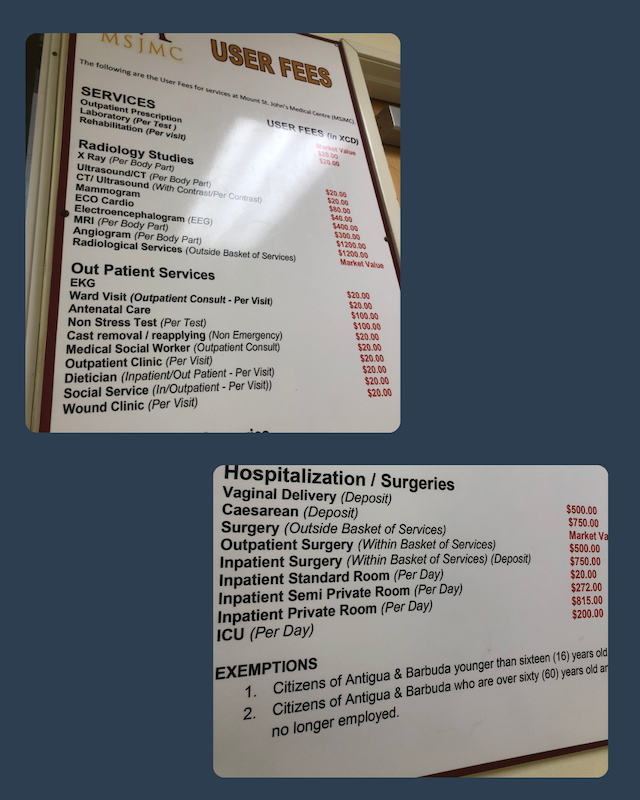
Care is free for patients under 16 and over 60. For everyone else, a fixed co-payment is required.
For outpatient care, this co-payment is fairly nominal, but beware: in the case of hospitalisation (inpatient), costs can quickly add up.
See below for a photo of the User Fees posted at Mount St. John's Medical Centre (MSJMC).
Private Insurance
If you are not covered by the Antiguan public scheme, taking out a private insurance policy is strongly recommended. The details of the various plans available to expats and tourists are beyond the scope of this article, but here is one essential point not to overlook.
Outpatient vs. Inpatient Care
Many expat insurance contracts do not cover outpatient care and are limited to hospitalisations and surgeries — and even then, only after submitting a prior request for guarantee of payment accompanied by a surgeon's quote, which must then be approved by the insurer's own physician.
It can be tempting to save on your premium by assuming you will simply pay out of pocket for the occasional doctor's visit. But beware: an emergency room visit, a cast after a fracture, a few stitches — all of these are outpatient procedures. The clinic will issue you a detailed invoice, and every blood test, every X-ray, every bandage will be on it.
Public and Private Healthcare Networks
There is only one hospital in Antigua: the Mount St. John's Medical Centre (MSJMC), recently renamed the "Sir Lester Bird Medical Centre", along with several public medical centres spread across the island.
There are also private clinics for more or less urgent care, as well as radiology centres and laboratories.
It is worth noting that many doctors work in both private clinics and the public hospital. A physician may see you at their private clinic and then follow up with you at the hospital if inpatient care becomes necessary.
Doctors in Antigua have often trained in Cuba, Canada, India or England, and are every bit as competent as their colleagues from those countries.
Sample Prices at Private Clinics
- General consultation: between 150 and 400 EC$ (approximately 55 to 150 USD)
- X-ray (e.g. to check for a fracture): approximately 500 EC$, results within minutes
- Annual eye exam: approximately 200 EC$
- Ophthalmology consultation: 800 EC$ (this happened to a friend after getting a splinter in the eye)
- Dental consultation: approximately 150 EC$
- Tooth extraction: approximately 350 EC$
As you can see, prices are often reasonable for routine care, and waiting times are generally short.
Cared for in Antigua: 3 Experiences, 3 Perspectives
A Broken Ankle
Patient not covered by Antigua's public health insurance scheme
A double ankle fracture. Off to the MSJMC emergency room!
35 minutes in the waiting room (we've seen far worse), followed by a fairly prompt assessment — except that the patient had no Antiguan health insurance card, so a credit card had to come out first.
X-ray, fracture reduction, cast: everything was completed within 3 hours by a highly competent team (an Antiguan orthopaedic surgeon trained in Cuba, an Indian surgeon, and a Canadian doctor).
However, an ankle fracture often requires surgery — and that surgery must be performed within a short window (no more than 7 days) before the bones begin to fuse on their own.
The hospital doctor was pushing for immediate admission. The patient, wisely, declined and instead asked the doctor to send over a medical report and a surgical quote as soon as possible.
After leaving the hospital, the patient consulted a private orthopaedic surgeon and requested a second quote. This surgeon, a former MSJMC practitioner himself, had online access to the X-rays taken the previous day at the hospital.
Here are the two surgical quotes received:
- Public hospital: 36,000 USD (including 3 nights of hospitalisation)
- Private clinic: 38,000 USD (one night at the clinic)
The patient chose the private clinic and emailed both the quote and the medical report to their insurance company (in the form of a "request for guarantee of payment").
In this case, the insurer was CIGNA, at a cost of 4,500 USD per year, with no outpatient coverage.
After roughly ten emails and a week of persistent phone calls to a call centre in Scotland, the insurer agreed to cover 95% of the quote, and surgery was scheduled without delay (the day after approval).
Emergency cares at the MSJMC (2000EC$), then follow-up post-operative visits (150 USD each) and physiotherapy sessions (110 EC$ each) were at the patient's own expense.
Example 2: Severe Hypotension Emergency
Permanent resident covered by Antigua's public health insurance scheme
Here is the account of a permanent resident who spent a full day between the Woods Urgent Care private clinic and the emergency department of Mount St. John's Hospital following a severe episode of low blood pressure. She compares her experience to what she would have gone through in the United Kingdom.
Between 11:00 a.m. and 2:30 a.m., she received:
- Consultation with a general practitioner (only 1 hour's wait)
- Blood tests with results within 1 hour
- Electrocardiogram (ECG) on site
- Intravenous drip of fluids and paracetamol
- Total cost for the first 5 hours: under £100 (approximately 135 USD)
When the Woods Urgent Care physician was unable to stabilise her blood pressure, an ambulance arrived within 5 minutes to transfer her to MSJMC (cost: 300 USD).
At the emergency department (from 4:30 p.m. to 2:30 a.m.):
- Triage within 15 minutes
- 5 electrocardiograms
- Brain scan (CT scan)
- 3 rounds of blood tests
- Doppler ultrasound of the legs
- Abdominal ultrasound
- Chest X-ray
- Continuous care by the same doctor and nurses throughout the entire day
All of this took place on a day when the local press was criticising the hospital for overcrowding, with patients in the hallways.
Her conclusion? In the UK, she believes she would still have been waiting for an ambulance or for admission to A&E. Under the NHS, she would almost certainly not have received all those tests in a single day. The waiting room would have been packed, with patients overflowing into the corridors.
She notes that Antigua may not have the very latest technology, but that the hospital system functions well.
Example 3: Childbirth
Mother covered by Antigua's public health insurance scheme
The mother, originally from Europe, was followed throughout her pregnancy at a private clinic. When the time came to give birth, her doctor joined her at the public hospital.
The delivery took place under conditions comparable to those in a European country. The mother, who had previously given birth in Italy, was able to compare the two experiences and noticed no significant difference in terms of quality of care.
While presenting her social insurance card was a matter of course, she was surprised to have to pay a deposit of approximately 600 EC$ upon admission. Before leaving, the hospital handed her a detailed invoice covering every expense related to her delivery, down to the last needle. The total came to approximately 1,500 EC$, if her memory serves her correctly.
Health Insurance: Essential for Expats
If you are not covered by Antigua's public health insurance scheme, arranging international health insurance is essential.
As the ankle fracture story illustrates, an uninsured person would have had to pay 38,000 USD out of pocket!
Even if you are covered by Antigua's public scheme but wish to have access to private or overseas care, supplementary insurance remains necessary.
Pay close attention to your coverage: many insurance plans only cover hospitalisation, meaning you are admitted to hospital and spend at least one night there.
A crucial point about age: most insurance companies will no longer accept new clients beyond a certain age, generally between 64 and 75 depending on the insurer, though some go up to 76 while others cut off at 64. Once a policy is in place, however, it can generally be renewed for life. Always check the specific terms, as each company has its own rules.
If you are planning to retire to Antigua, don't wait! Take out your international insurance before reaching these age limits, as it will become very difficult, if not impossible, to find affordable coverage afterwards.
In conclusion: if you plan to live in Antigua, a good international health insurance policy is strongly recommended (Cigna Global, Allianz, IMG, among others). This type of policy:
- covers treatment in Antigua as well as medical evacuation and overseas care
- is fairly expensive: typically between 400 and 800 USD per month
- is essential for serious conditions requiring treatment outside Antigua
Other Options
Europeans are in luck: agreements exist for EU citizens who sometimes travel to Guadeloupe, Saint-Martin, or Martinique for major medical procedures (surgery, MRI, cancer treatment, and so on).
Medical Evacuation: Don't Overlook It
Here is an important point that many expats tend to overlook: medical evacuation insurance.
For complex conditions (serious cardiac or neurological emergencies, complex surgery, cancer treatment, advanced orthopaedic procedures), evacuation to Miami (approximately 3 hours away), Barbados (a regional medical hub), or other major medical centres may be necessary.
The cost of evacuation without insurance? Between 25,000 and 100,000 USD!
Most comprehensive international health plans include evacuation coverage. However, be aware that some plans do not allow treatment in the United States.
Standalone evacuation policies are also available through providers such as International SOS and Medjet. This is truly essential peace of mind when living on a small island.
Key Takeaways
- Routine care and emergencies are handled competently
- Common medical issues (infections, minor injuries, chronic disease management) are well catered for
- Emergency care is available 24/7
- Limitations exist for advanced diagnostics, complex surgeries, specialist treatments, and cancer care, which often require travelling abroad
Important tip: if you rely on regular medication, make sure you have a sufficient supply during your transition period and check whether your medications are available locally. Some expats maintain mail-order prescriptions from their home country to save on costs.
Have you heard of ABSAR?
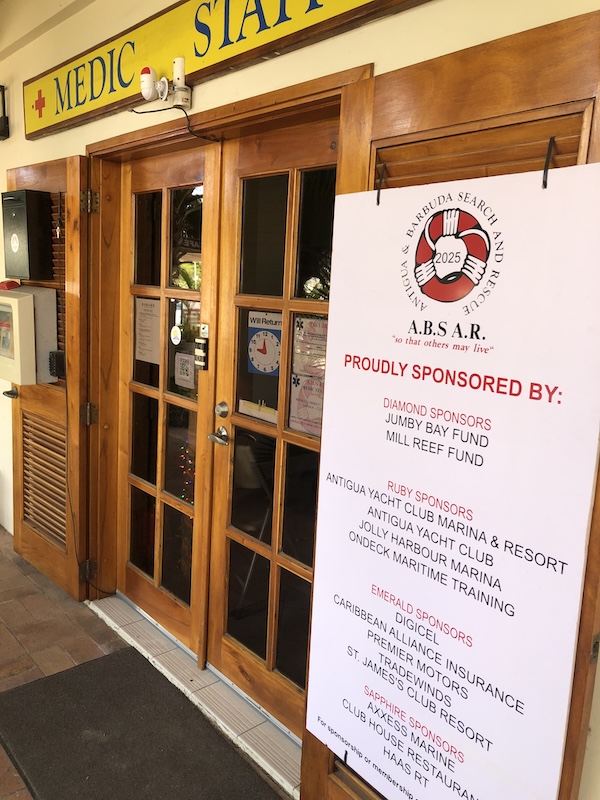
Based at English Harbour marina, they respond to all land and maritime emergencies. Whether it's a sea urchin in your foot or something more serious, their medical centre is there for you. They are a non-profit organisation — please consider supporting them. https://www.absar.org
Useful Numbers
- Emergency services (ambulance, police, fire): 911
- ABSAR at English Harbour: (268) 720-3992 — Opening hours: Monday to Friday, 9 a.m. to 5 p.m. — Marine radio: VHF-16 (Falmouth Harbour and Barbuda)